
Some couples get pregnant
easily, others need what we do.
One field, one career
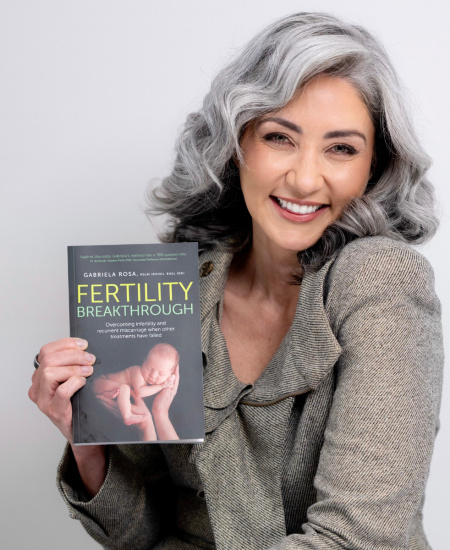
Dr. Gabriela Rosa has been helping individuals and couples overcome infertility, recurrent miscarriages, and failed treatments since 2001. She is a Harvard trained clinician-scientist working at the intersection of naturopathic medicine, reproductive medicine, and clinical research.
The people who reach her have usually been investigated already. And they are still looking, because none of the answers so far has produced their baby.
Fertility outcomes are driven by factors that can be identified, measured, and in many cases changed. Not luck. When a case is called unexplained, what that usually means is that the investigation available to you, or the one someone was willing to order, found nothing. Those are two different statements.
Dr. Rosa is the author of Fertility Breakthrough: Overcoming infertility and recurrent miscarriage when other treatments have failed (Rethink Press, 2019), and the creator and host of The Fertility Challenge™, a free, evidence-based program that has run since 2011, with participants in more than 111 countries. More than 226,000 people have taken part in her programs since 2001.
What the work is
Three things underpin her method. Both partners are investigated in depth, as one case, not only the woman. Results are reviewed and interpreted in relation to each other and to the rest of the history, not one at a time against a population or laboratory range alone. What is found is treated in the whole person, not in a single organ or system. For solo parents by choice, the assessment and treatment are equally comprehensive.
Routine care stops well short of this. That is one of the most obvious gaps her programs close, and not the only one.
She codified it as the F.E.R.T.I.L.E. Method® because a program run by only one person would carry a waitlist measured in years and, worse, would not be better care. Her work is refining what improves live birth outcomes; the clinical team she trains and oversees delivers it.
Although IVF or donor eggs in combination with what we do may be the right answer for some couples we treat, neither is ever the first step, because knowing what to do requires first knowing what is wrong. Where escalation is what the case needs, our team says so and prepares patients for that next step.
“First, we find the obstacles. Then we treat what is wrong, not
what is unexplained.”
Dr. Gabriela Rosa
The evidence, and its limits
In a single arm prospective cohort of Rosa Institute patients analyzed per protocol, with no comparison group, research completed at the Harvard T.H. Chan School of Public Health on cases treated between 2014 and 2021, 78.8% of patients in our signature program went on to a live birth (n=544): 47.7% without assisted reproductive technology (ART) and 31.1% with it. 5.6% of the cohort used donor eggs. Presented as a poster at the British Fertility Society 2022.1 The patients in this cohort arrived after a mean of 3.6 years (± 2.7 years) without a viable pregnancy, 45.6% after a failed embryo transfer. Mean time to live birth was 21.7 months (± 12.1 months), including the pregnancy.
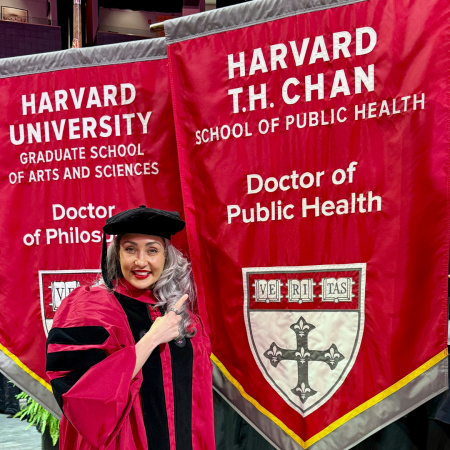
Her doctoral research is INSPIRE. A randomized controlled trial of structured expressive writing for infertility related trauma, grief, and quality of life. Conducted in the Mahalingaiah Lab at the Harvard T.H. Chan School of Public Health, supervised by the lab’s director, Dr. Shruthi Mahalingaiah, a reproductive endocrinologist at the Mass General Hospital Fertility Center. Doctorate conferred 2026. Trial recruitment ongoing. The results of one study are not evidence for the other.
Qualifications
- Doctor of Public Health (DrPH), Harvard T.H. Chan School of Public Health, 2026
- Master of Public Health (MPH), Clinical Effectiveness, Harvard T.H. Chan School of Public Health, 2022
- Master of Science in Medicine (MScM), Reproductive Health and Human Genetics, University of Sydney, 2013
- Bachelor of Health Science, Naturopathy, University of New England, 2006
- Advanced Diploma of Naturopathy, Nature Care College, 2001
Every post-graduate degree earned while still seeing patients and running The Rosa Institute.
The Rosa Institute
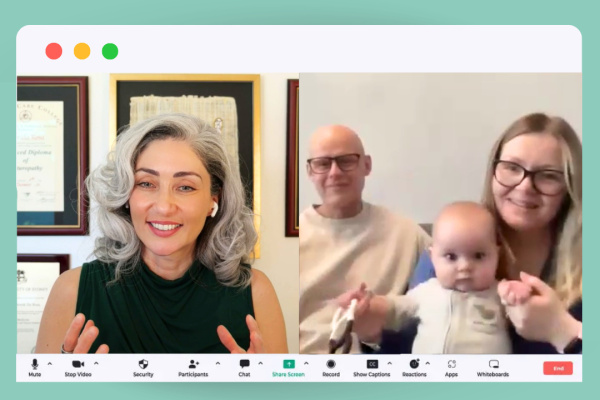
A telehealth practice headquartered in Sydney, Australia, caring for patients on six continents, with more than twenty clinicians and staff across five timezones. Places in our signature program are capped, because a clinical team can hold only so many cases well.

has something left to find
Book a complimentary Fertility Discovery Call with our Patient Care Coordinators. Straight answer either way, including where to look if it is not with us.
REFERENCE
1. Rosa G, et al. Live birth outcomes of a novel, telehealth-based integrative medicine intervention for infertile patients. Human Fertility. 2022;25(4):789. doi:10.1080/14647273.2022.2074466